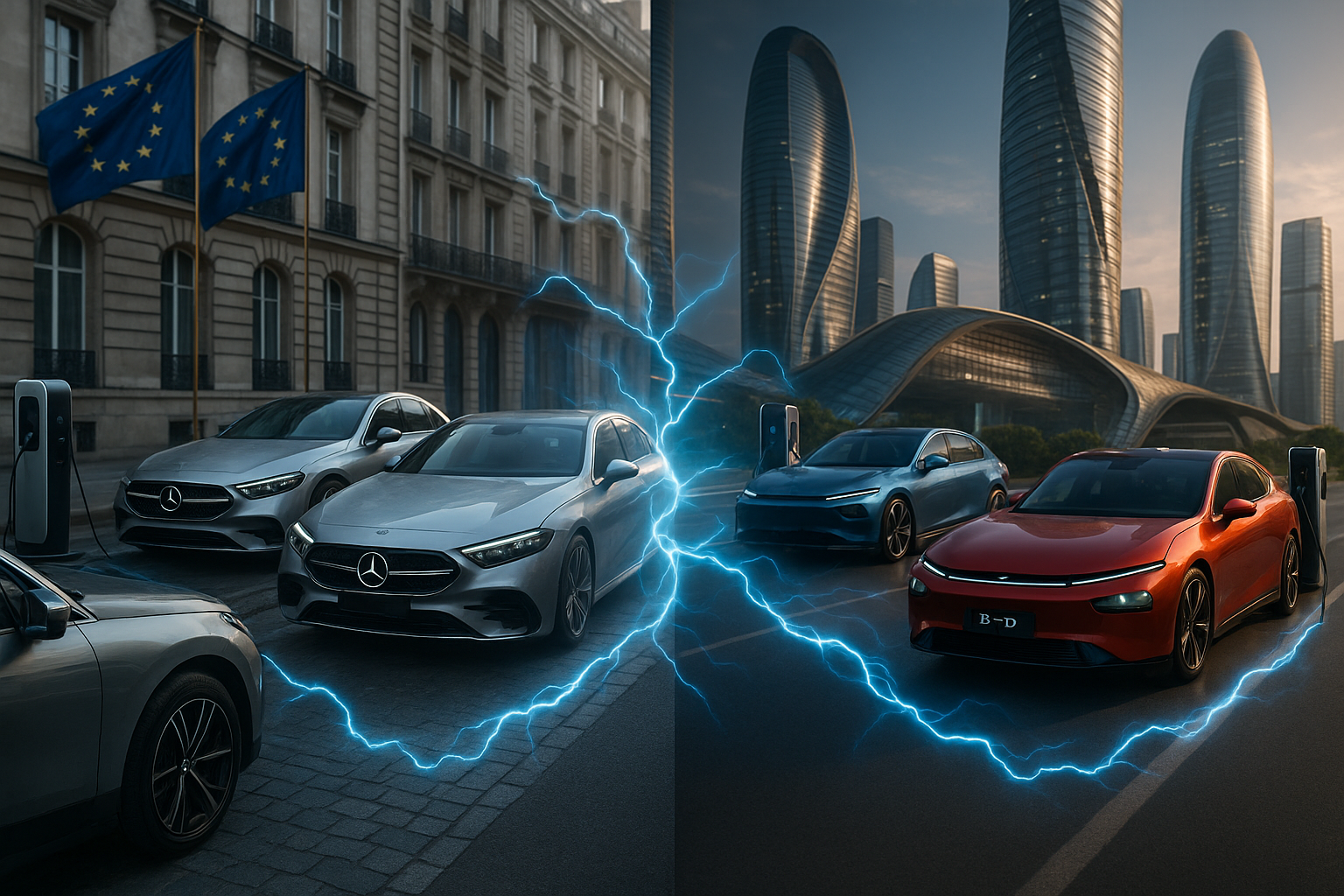
Automotive revolution: the EU will not give up in the electric vehicle race with China
The global automotive industry is undergoing tectonic shifts, with China at the epicenter. European carmakers, once the undisputed market leaders, have found themselves in the role of followers, trying to resist the rapid expansion of Chinese electric vehicles. This news reveals three key aspects of this “automotive revolution”: the EU's firm stance, the call for European carmakers to accelerate, and the clear technological superiority of electric vehicles.
The EU is not backing down: refusal to make concessions and a firm stance
Despite lobbying by European automotive giants, the European Commission is standing firmly by its position: the goal of a complete transition to electric vehicles by 2035 remains in force. At a recent summit, already the third “crisis meeting” with carmakers, the EU rejected requests to ease the requirements. “The future of cars is electric, despite everything” — this is the leitmotif of European policy.
This tough stance is supported by impressive statistics: while in 2020 electric vehicles (BEV + PHEV) accounted for 11% in Europe compared with 5% in China, by 2024 China had made an incredible leap, reaching 47% compared with Europe’s 24%. This gap clearly shows that while European manufacturers were asking for delays, China was taking action.
European carmakers: time to accelerate, not ask for concessions
While European automotive groups are trying to maintain the status quo by clinging to hybrids and internal combustion engines, Chinese companies are actively conquering the European market. Brands such as Xpeng and GAC have announced aggressive expansion plans. Xpeng plans to introduce its mass-market Mona series to the European market next year, with prices in China starting at 17 000 dollars. GAC aims to sell at least 50 000 cars in Europe by 2027.
The market share of Chinese brands in Europe has already nearly doubled in the first half of 2025, exceeding 5%. And this is only the beginning. Chinese manufacturers are building factories in Europe: BYD will launch production in Hungary in October 2025 and plans to open a second factory in Turkey in 2026, with a capacity of up to 500 000 cars per year.
While European companies such as BMW unveil new technologies based on two-year-old platforms, Chinese competitors are bringing new models to market at an astonishing pace. As experts note, “commitment to outdated structures and incrementalism has slowed the ability to build a credible electric vehicle ecosystem”.
The technological superiority of electric vehicles: a new reality
The debate over the future of the automotive industry is increasingly shifting from ecology to technology. As Audi CEO Gernot Döllner stated: “electric vehicles are simply better technology.” Chinese manufacturers are actively proving this proposition in practice. They position themselves as technology companies, offering cars with large screens, advanced interfaces, voice assistants, and even options such as built-in refrigerators and massage seats.
However, China's main advantage is the result of a well-considered industrial policy pursued over many years. From establishing joint ventures in the 80s and 90s, through the electric vehicle subsidy program and the “Made in China 2025” strategy, the country has purposefully moved toward dominating this field. Geely's acquisition of Volvo in 2010 provided access to premium technologies and global distribution networks. In 2023, China surpassed Japan to become the world's largest car exporter.
Conclusion: The “automotive revolution” is not simply a transition to a new type of engine. It is a changing of global leaders, a rethinking of business models, and a technological race in which China has surged far ahead. European carmakers must make every possible effort to avoid being left on the sidelines of this revolution.
Key facts and figures
Market share comparison (2020 vs 2024):
•Europe: 11% → 24% (electric vehicles + hybrids)
•China: 5% → 47% (electric vehicles + hybrids)
China's expansion plans in Europe:
•Xpeng: Mona series launch in 2026 (starting at $17,000)
•GAC: 3,000 cars in 2025 → 50,000 cars by 2027
•BYD: Hungary factory October 2025, Turkey factory March 2026 (500,000 cars/year)
Growth of China’s market share in Europe:
•First half of 2025: nearly doubled (over 5%)
Expert assessments:
•“Electric vehicles are simply the better technology” (Audi CEO)
•“The Chinese certainly won’t wait for anyone to catch up” (Counterpoint Research)
•“Even if the Commission were to withdraw these targets, global competition would impose them on the industry” (EU official)
To provide the best experiences, we use technologies like cookies to store and/or access device information. Consenting to these technologies will allow us to process data such as browsing behavior or unique IDs on this site. Not consenting or withdrawing consent, may adversely affect certain features and functions.
Functional
Always active
The technical storage or access is strictly necessary for the legitimate purpose of enabling the use of a specific service explicitly requested by the subscriber or user, or for the sole purpose of carrying out the transmission of a communication over an electronic communications network.
Preferences
The technical storage or access is necessary for the legitimate purpose of storing preferences that are not requested by the subscriber or user.
Statistics
The technical storage or access that is used exclusively for statistical purposes.The technical storage or access that is used exclusively for anonymous statistical purposes. Without a subpoena, voluntary compliance on the part of your Internet Service Provider, or additional records from a third party, information stored or retrieved for this purpose alone cannot usually be used to identify you.
Marketing
The technical storage or access is required to create user profiles to send advertising, or to track the user on a website or across several websites for similar marketing purposes.