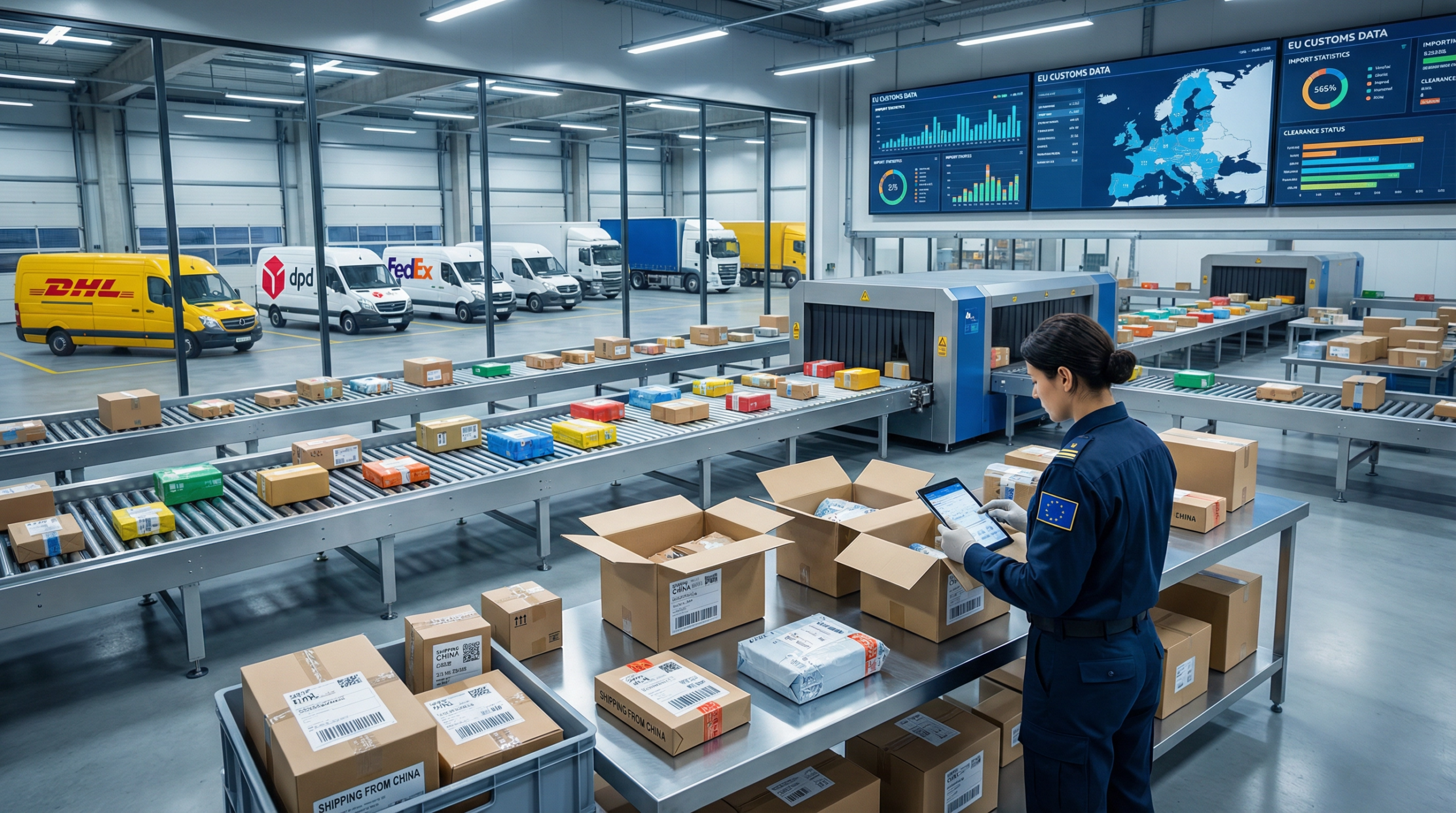
Reform of EU customs rules and e-commerce: How new laws will change the market in 2026
13.04.2026
The European Union has launched its most extensive reform of customs legislation since 1968 . Nende muudatuste peamine eesmärk on võidelda ebaausa konkurentsi vastu, mis tuleneb Euroopa-välistest turgudest ja odavate kaupade müüjatest, ning kaitsta siseturgu ja Euroopa tarbijaid. E-kaubanduse kiire kasvu tingimustes, kus miljonid pakid ületavad iga päev ELi piire, ei vasta vanad eeskirjad enam tänapäevastele väljakutsetele.
The new EU customs rules will have a huge impact on the e-commerce market, affecting major players such as AliExpress, Temu and Shein, as well as ordinary shoppers who are accustomed to ordering inexpensive goods from China and other third countries. In this article, we analyse in detail the key changes, their consequences for businesses and consumers, and how online platforms must adapt to the new realities.
Abolition of the €150 threshold: The end of the era of low-cost parcels
One of the most important and widely discussed changes under the EU customs reform is the so-called de minimis abolition of the threshold . Previously, parcels worth up to 150 euros were completely exempt from customs duties. This exemption was introduced to simplify the handling of small consignments, but as cross-border e-commerce developed, it became a huge loophole for evading taxes and customs duties.
According to the European Commission, around 5.8 billion small parcels arrived in the EU in 2025, and over 90% came from China.. A huge quantity of these goods was imported without customs duties being paid, placing European manufacturers and retailers at an extreme disadvantage. Moreover, many sellers deliberately understated the declared value of goods to remain within the 150-euro limit and avoid additional costs.
How will this work now?
De minimis with the abolition of the exemption, all goods imported into the European Union from third countries will be subject to customs duty regardless of their value. To simplify calculations during the initial stage, the EU plans to introduce, from 1 July 2026, a fixed fee of 3 euros for each parcel worth up to 150 euros .
However, this fee is not universal. Customs algorithms take into account the characteristics and category of the goods. For example, if a buyer orders 10 pairs of identical socks, they pay a one-time fee of 3 euros. However, if the order contains 5 pairs of wool socks and 5 pairs of cotton socks, the system classifies them as different types of products, and the customs duty rises to 6 euros . A full transition to the new system is planned by 2038, when all operators will be required to work according to uniform European standards.
For European consumers, this means an inevitable increase in the price of cheap goods from third countries. Shopping on popular Chinese marketplaces is becoming less worthwhile, as customs duties are now always added to the price of goods, along with potentially additional fees for payment processing and logistics.
Platform responsibility: Online shops become importers
The second fundamental aspect of the reform is the radical transformation of the liability of e-commerce platforms . Until now, marketplaces such as Temu, Shein or AliExpress have operated merely as intermediaries between a seller from a third country and a buyer located in the EU. Responsibility for compliance with taxes, customs duties and safety standards fell on the end consumer, who was formally regarded as the importer.
Now the legal burden is being completely reversed. Under the new rules, online platforms and marketplaces are officially considered as importers. This means that they bear full responsibility for the following:
1.Payment of customs duties and VAT: Platforms must collect all necessary fees at checkout on the website so that the goods can cross the EU border without hindrance.
2.Compliance with product safety standards: Marketplaces are required to ensure that goods sold through their platforms comply with strict European safety, environmental and consumer protection standards.
3.Andmete esitamine: Platvormid peavad eelnevalt edastama üksikasjaliku teabe kaupade kohta ELi tolliasutustele spetsiaalse süsteemi (EU Customs Data Hub) kaudu enne kaupade jõudmist piirile .
Fines and sanctions for violations
The European Union is determined to ensure compliance with the new rules. If marketplaces systematically violate the requirements or allow dangerous and uncertified goods to be sold, they will face severe financial penalties. Under the agreements reached, fines may range from 1% to 6% of a company’s total annual turnover in Europe .
According to regulators, between 60% and 65% of certain categories of goods (such as cosmetics, toys, and personal protective equipment) currently arriving from outside the EU do not meet European safety standards . Placing responsibility on marketplaces is intended to radically change this situation and protect European citizens from low-quality and potentially dangerous products.
Single customs authority: Centralization of control (EU Customs Authority)
The third important element of the reform is the establishment of a centralized EU Customs Authority (EU Customs Authority) . Currently, customs controls in the European Union are carried out by the national authorities of 27 Member States. Despite the existence of a common customs code, the practical implementation of the rules often varies greatly depending on the country through which the goods enter the EU.
Unscrupulous sellers actively exploit these differences by routing trade flows through countries with more lenient controls or outdated IT systems. The existence of more than 2000 border crossing points without a strictly harmonised protocol for recording violations creates ideal conditions for customs fraud .
Functions and responsibilities of the new authority
The creation of EU Customs Authority is intended to eliminate this fragmentation and ensure a unified, standardized approach to customs controls at all of the EU's external borders. The main functions of the new authority are as follows:
•Administration of the single data hub (EU Customs Data Hub): This will be a powerful IT platform, replacing more than 100 different national customs systems. All data on goods, importers and logistics chains will be consolidated in a single database.
•Risk analysis at EU level: Thanks to centralized data collection, customs authorities can use artificial intelligence algorithms to more effectively identify suspicious shipments, smuggling, and dangerous goods.
•Coordination of the activities of national customs authorities: EU Customs Authority will direct the work of national authorities, ensuring the uniform application of rules and standards throughout the European Union.
It is expected that the first stages of the work of this regulatory authority and single data hub will be launched in 2028. year, and the transition to the new system will be completed by 2038 .
Impact of the reform on the e-commerce market and consumers
The wide-ranging EU customs reform will inevitably bring tectonic shifts to the cross-border e-commerce market. Let us examine the main consequences for the various participants in the process.
For European consumers
For ordinary buyers, the main and most obvious consequence is increase in the prices of cheap foreign goods. Abolishing the €150 threshold and introducing fixed fees will make buying inexpensive accessories, clothing or electronics from Chinese marketplaces less attractive.
On the other hand, consumers can of a higher level of protection. Since the platforms themselves are now responsible for the quality of goods, the risk of receiving a dangerous toy or toxic cosmetics will decrease significantly. In addition, the delivery process should become more transparent and predictable, as all customs procedures will be integrated into the purchasing process.
For Asian marketplaces (Temu, Shein, AliExpress)
The new rules pose a serious challenge to Chinese e-commerce giants. The business model based on sending millions of ultra-cheap parcels directly to consumers while taking advantage of tax exemptions will no longer work in Europe.
Platforms must:
•Restructure their IT systems to integrate with the European customs hub.
•Assume the functions of a tax agent and collect customs duties from buyers.
•Strengthen controls over suppliers and the quality of goods to avoid multimillion-euro fines.
•Possibly review their logistics chains and open more local warehouses in the EU to optimize costs.
Some experts are already calling the upcoming changes the “Temu and Shein tax”, emphasizing that the reform will primarily affect these companies' business model .
For European businesses and logistics
European manufacturers and retailers have long lobbied for these changes. They expect that the reform levels the playing field and protects them from unfair competition from companies that do not pay taxes or comply with European standards.
Logistics companies, such as national postal operators and courier services, will also benefit from data centralization. The implementation of uniform and transparent rules should eliminate bureaucratic chaos and streamline the operations of international delivery services .
Summary
The reform of European Union customs legislation is not merely an update of old rules, but a complete overhaul of the cross-border trade system. Abolishing the 150-euro threshold, placing responsibility on marketplaces, and establishing a single customs authority (EU Customs Authority) are intended to make the e-commerce market more transparent, secure, and fair.
Although European consumers may face price increases for familiar goods from China in the short term, these measures should strengthen the EU internal market, improve the quality of imported products and ensure fair competition in the long term. For marketplaces, an era of new standards and heightened responsibility is beginning, and adapting to it will require significant effort and investment.
To provide the best experiences, we use technologies like cookies to store and/or access device information. Consenting to these technologies will allow us to process data such as browsing behavior or unique IDs on this site. Not consenting or withdrawing consent, may adversely affect certain features and functions.
Functional
Always active
The technical storage or access is strictly necessary for the legitimate purpose of enabling the use of a specific service explicitly requested by the subscriber or user, or for the sole purpose of carrying out the transmission of a communication over an electronic communications network.
Preferences
The technical storage or access is necessary for the legitimate purpose of storing preferences that are not requested by the subscriber or user.
Statistics
The technical storage or access that is used exclusively for statistical purposes.The technical storage or access that is used exclusively for anonymous statistical purposes. Without a subpoena, voluntary compliance on the part of your Internet Service Provider, or additional records from a third party, information stored or retrieved for this purpose alone cannot usually be used to identify you.
Marketing
The technical storage or access is required to create user profiles to send advertising, or to track the user on a website or across several websites for similar marketing purposes.