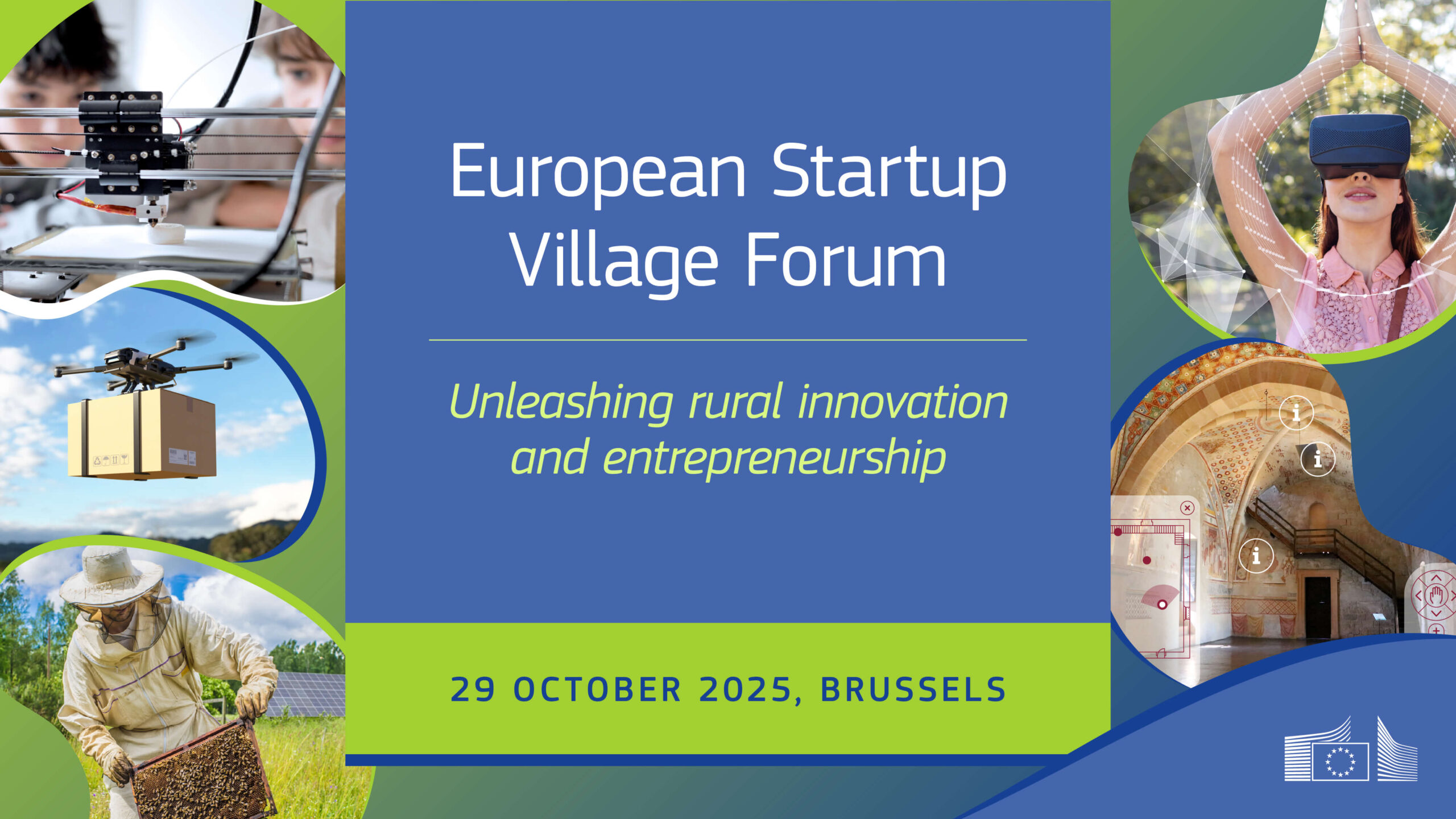
European Startup Village Forum 2025: How Rural Areas Are Becoming New Innovation Hubs
27 October 2025
Brussels, Belgium – On 29 October 2025, the third annual European Startup Village Forum will take place in Brussels, a pivotal event organised by the European Commission's Joint Research Centre (JRC). The Forum highlights the transformation of rural areas across the European Union into vibrant hubs of innovation and entrepreneurship. This year's event will feature compelling case studies from Slovenia, France, Italy and Finland, showing how a forward-looking approach can unlock the enormous potential of rural areas. The Forum is one of the EU's of the long-term vision for rural areas cornerstones – it is a comprehensive strategy aimed at making these regions stronger, better connected, more resilient and more prosperous by 2040.
The heart of the matter: the Startup Village concept
The “Startup Village” concept is central to the forum's mission. It represents a shift in perspective, viewing rural areas not as passive recipients of support but as dynamic ecosystems capable of driving cutting-edge, startup-based innovation. The forum provides a platform for stakeholders—from local government leaders and entrepreneurs to EU policymakers and researchers—to exchange knowledge, share best practices and jointly develop the strategies needed to foster these emerging innovation hubs.
This initiative involves creating favourable conditions for business development outside urban environments. This includes ensuring access to digital infrastructure, fostering a supportive business environment, and connecting rural innovators with broader networks and funding opportunities. The ultimate goal is to bridge the innovation gap between urban and rural areas, ensuring that all of Europe can contribute to and benefit from the green and digital transitions. This is particularly important for countries such as Estonia, where regional development and the vitality of rural areas are of strategic importance.
A vision for thriving rural Europe
The European Startup Village Forum is the EU's long-term vision for rural areas flagship initiatives. This ambitious vision, looking ahead to 2040, recognises the unique challenges facing rural areas—such as population decline, brain drain and infrastructure gaps—and provides a comprehensive framework for addressing them. The vision is built on four pillars: making rural areas stronger, better connected, more resilient and more prosperous.
•Stronger: Empowering local communities, improving access to public services, and promoting social innovation. This means investing in education, healthcare, and local cultural life to create an attractive living environment for people of all ages.
•Better connected: Improving transport and digital connectivity and creating stronger links between rural and urban areas. Today, high-speed internet access and good transport options are as essential as water and electricity, enabling remote work and the emergence of new business models.
•More resilient: Protecting natural resources, advancing climate action and supporting the transition to a sustainable food system. Rural areas are on the front line of climate change, but they also have unique potential to be part of the solution, for example through renewable energy production and the circular economy.
•More prosperous: Diversifying economic activity, promoting entrepreneurship and creating high-quality jobs. This means modernising traditional sectors such as agriculture and forestry and developing new areas such as tourism, green technology and the creative industries.
The Forum contributes directly to these objectives by showcasing successful models of rural innovation and providing a space for policy learning and co-creation. It highlights how targeted investments and supportive policies can create an environment where rural start-ups can thrive, attracting talent and generating economic growth. This is also an important message for Estonia, where making better use of the potential of rural areas is key to economic development.
Pioneers of rural innovation: stories from the field
1.One of the highlights of this year's forum is the session “Experiences from the Territories: Listening to the Voice of Startup Villages”, where representatives from four countries will share their journeys:
•Slovenia (Municipality of Kočevje): Mayor Gregor KOŠIR explains how Kočevje, a region once known for its vast forests and struggling industry, is reinventing itself as a hub for green technologies and sustainable tourism. The municipality has actively supported the development of the local innovation ecosystem, attracting start-ups and creating new opportunities for its residents.
•France (Vosges municipality): Julia MARITON from the Quai Alpha incubator explains how this initiative in the Vosges Mountains helps launch and scale startups in sectors such as digital services, agritech and ecotourism. Quai Alpha provides essential support, including mentoring, access to funding and a collaborative workspace, demonstrating the power of a dedicated incubator in a rural area.
•Italy (Laconi municipality): Carlo CONI, founder of a rural coworking centre in Laconi, Sardinia, shares his experience of building a vibrant community of entrepreneurs and remote workers in a small inland village. His initiative is a powerful example of how digital connectivity can reverse population decline, enabling people to live and work in areas rich in culture and nature.
•Finland (Municipality of Saarijärvi): Business Development Specialist Ilona UKKONEN discusses how Saarijärvi is leveraging its strengths in forestry, bioenergy and digital solutions to build a thriving rural economy. The municipality has implemented a proactive strategy to support entrepreneurs, focusing on sustainability and the circular economy.
These real-world examples offer invaluable insights into the diverse paths of rural innovation, demonstrating that there is no one-size-fits-all solution. They highlight the importance of place-based strategies that build on the unique assets and strengths of each territory.
Expert Opinions and Political Dialogue
The Forum's agenda is packed with high-level discussions on the key drivers of rural innovation. The opening session will feature prominent figures from the European Commission, including directors from JRC and the Directorates-General for Agriculture and Rural Development, Research and Innovation, and Regional and Urban Policy. This underlines the cross-cutting importance of rural innovation in EU policy.
The session “New Evidence on Rural Innovation and Entrepreneurial Ecosystems” will feature leading experts from JRC, OECD and Utrecht University, who will present the latest research on what makes rural innovation ecosystems work. This evidence-based approach is essential for designing effective policies and interventions.
The afternoon panels will delve into practical strategies for “Harnessing Entrepreneurial Potential in Rural Areas” and explore “Policies and Tools to Foster Innovation and Entrepreneurship in Rural Areas”. These sessions will bring together a diverse range of voices, including representatives from Euroopa Investeerimisfond, national and regional authorities, and successful rural entrepreneurs such as Carl PUCCI from Estonia, founder of the start-up EO59.
The day will conclude with a keynote speech by Professor Luc SOETE, “Ensuring the Freedom to Remain in Europe's Rural Areas” – a powerful concept that encapsulates the ultimate goal of the vision for rural life: to create a future where people have the choice to build fulfilling lives and careers in rural areas, rather than being forced to leave in search of opportunities.
Estonia's Role and the Way Forward
The inclusion of Estonian entrepreneur Carl PUCCI in the programme underlines the importance of this topic for the Baltic region. With its strong digital infrastructure and vibrant start-up landscape, Estonia is well positioned to be a leader in rural innovation. Lessons learned from the Startup Village Forum can help inform and inspire similar initiatives across Estonia and neighbouring countries.
The Brussels Forum is more than just a conference; it is a catalyst for change. By bringing together the brightest minds and most inspiring stories from rural Europe, it aims to create a movement that will reshape the future of the continent's rural areas. For those unable to attend in person, the event will be livestreamed, offering a unique opportunity to be part of this important conversation.
The message from Brussels is clear: Europe's future is not only in its cities. It is also in its villages, rural areas and remote regions. With the right support and a bold vision, these regions can become engines of a more sustainable, inclusive and prosperous European Union. For Estonia, this is an opportunity to learn from best practices and apply them to accelerate the development of its rural areas, ensuring that innovation and prosperity reach every corner of Estonia.
To provide the best experiences, we use technologies like cookies to store and/or access device information. Consenting to these technologies will allow us to process data such as browsing behavior or unique IDs on this site. Not consenting or withdrawing consent, may adversely affect certain features and functions.
Functional
Always active
The technical storage or access is strictly necessary for the legitimate purpose of enabling the use of a specific service explicitly requested by the subscriber or user, or for the sole purpose of carrying out the transmission of a communication over an electronic communications network.
Preferences
The technical storage or access is necessary for the legitimate purpose of storing preferences that are not requested by the subscriber or user.
Statistics
The technical storage or access that is used exclusively for statistical purposes.The technical storage or access that is used exclusively for anonymous statistical purposes. Without a subpoena, voluntary compliance on the part of your Internet Service Provider, or additional records from a third party, information stored or retrieved for this purpose alone cannot usually be used to identify you.
Marketing
The technical storage or access is required to create user profiles to send advertising, or to track the user on a website or across several websites for similar marketing purposes.