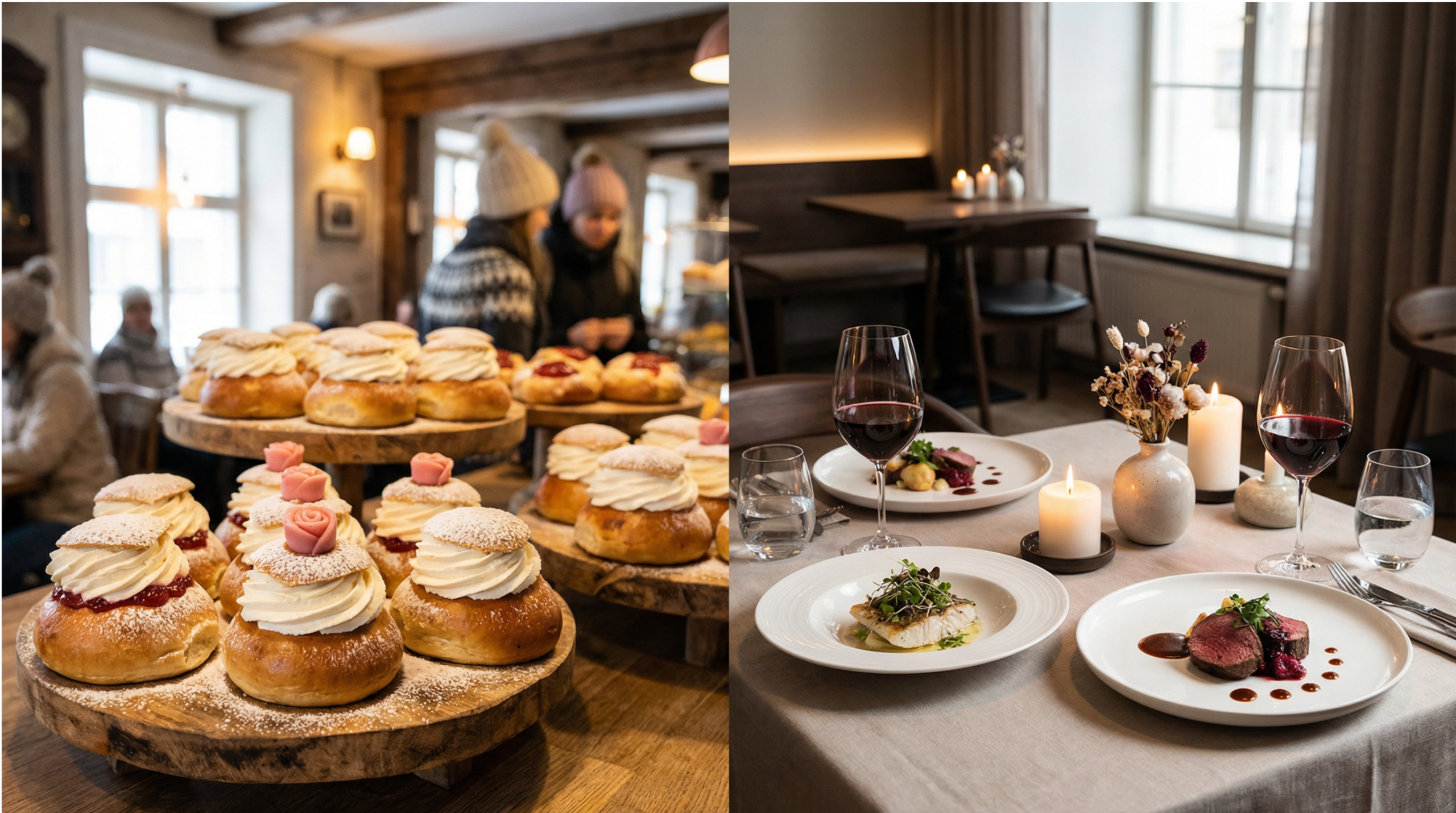
Gourmets’ Days of Delight: Kuklifest Tallinnas and Maitsev Tartu invite you to discover the world of Estonian flavours
February is shaping up to be a true month of culinary delights in Eestis. While Kuklifest, the now-traditional festival of Shrove buns, is already in full swing in the capital, the acclaimed restaurant month “Maitsev Tartu” begins its parade of flavours in Tartus on 2 February. Eesti's two largest cities thus offer a rare opportunity to immerse oneself in the heart of local gastronomy, discovering both ancient traditions and contemporary culinary trends. This is the story of two festivals that reflect the richness and diversity of Eesti food culture and have become an important part of the winter calendar for both local residents and tourists.
Kuklifest 2026: The Shrove Tuesday bun as a symbol of cultural heritage
Tallinn has once again become the capital of traditional Shrove buns, as Kuklifest returns for the second consecutive year from 15 January to 17 February 2026. It is a unique winter food festival dedicated to one of Eesti's most beloved treats—the traditional Shrove bun. The festival's idea is simple but brilliant: why limit the enjoyment of traditional Shrove buns to just one day when an entire month can be devoted to them?
More than 40 cafés and bakeries from across Tallinn participate in Kuklifest, offering visitors over 120 different versions of this classic pastry to discover. It is a true paradise both for lovers of traditional flavours and for those seeking new and unexpected experiences. The selection includes classic buns with whipped cream and jam, as well as exciting variations with cinnamon, cardamom, vanilla custard, marzipan and even savoury additions. Each participating café has created its own unique vision of the perfect vastlakukkel, turning the festival into a journey of discovery through the flavours of the city.
The story of the vastlakukkel: more than just a bun
The tradition of vastlakukkel is deeply rooted in the cultural history of Eesti and, more broadly, all of Põhja-Euroopa. Its history dates back to the Middle Ages and is closely connected with the celebration of vastlapäev, or Shrove Tuesday—the last day before the beginning of the 40-day Lenten fast. As Reet Bender, Associate Professor of German Language and Culture at Tartu Ülikool, explains, this was the day when all the fresh and rich foods prohibited during Lent had to be used up. This is how sumptuous desserts, including the precursors of Shrove buns, came into being.
The tradition reached Estonia through the Baltic Germans, who dominated the local cultural sphere for centuries. Originally, these buns did not resemble their modern-day counterparts. Recipes from the 18th century describe luxurious “heiße Wecken,” or “hot buns.” The tops were cut off, the insides hollowed out and mixed with rose water, butter, milk, almonds, vanilla, sugar, and raisins. This new, rich filling was placed back inside the bun, covered with the “lid,” and baked again in the oven. They were served warm, straight from the oven.
The cold version filled with whipped cream that we know today did not become widespread until shortly before the Second World War. The popularity of whipped cream in Estonian and Latvian desserts can be explained by our agrarian past – dairy products, including cream, were always available, even in difficult times. Although the modern version is simpler, it remains beloved and gives bakeries an opportunity to showcase their creativity.
One of the important aims of Kuklifest is to showcase this rich heritage. The festival is not merely a confectionery fair, but a cultural event that tells stories about bakers, traditions, and Tallinn's café culture. Visitors can hear stories about people who have traded office work for the early-morning scent of cardamom or who create pastries with architectural precision.
Scope and participants of the festival
The scope of Kuklifest is impressive. The list of participants includes well-known and beloved names as well as new and exciting places. They include, for example:
Café/Bakery
Notes
Karjase Sai
Known for its artisan bread and pastries.
La Boulangerie
A piece of Paris in the heart of Tallinn, offering French classics.
Fotografiska Kohvik
Combining culinary art with a sustainable mindset.
Eesti Vabaõhumuuseum
Offers the opportunity to taste traditional Shrove buns in a historic setting.
Sweet yeast dough
Known for its rich braided sweet breads and now also its Shrove buns.
In addition to these, dozens of other cafés are participating, all contributing to the festival's diversity. The festival's official website and social media channels provide a complete list and map to help you plan your sweet adventure through Tallinn.
This festival is an excellent example of how a traditional food can unite a community, support local businesses, and bring joy to both city residents and visitors. It is an invitation to discover, taste, and celebrate one of the most delicious symbols of the Estonian winter.
Maitsev Tartu 2026: A gourmet journey through the capital of Southern Estonia
While Tallinn tempts those with a sweet tooth, Tartu invites gourmets on a journey of discovery through the restaurant world. 2–28 February 2026, the acclaimed restaurant month “Maitsev Tartu” will take place for the twelfth time. Over the years, the event has grown into one of the most important gastronomic events in Eestis, bringing together the city's best restaurants and most passionate food lovers.
“Maitsev Tartu” was created with the aim of bringing warmth, light and dazzling culinary experiences to the otherwise cold and dark month of February. First held in 2015, the festival has proven that good food can withstand any weather. Over the years, the head chefs of Tartu restaurants have created 199 special menus, and as of 2024, visitors have enjoyed more than 168 000 three-course set menus.
Festival concept and menus
The “Tasty Tartu” campaign focuses on special three-course menus created specifically for this month and offered at a lower-than-usual price. In 2026, 26 restaurants will participate in the festival, and the top-quality special menus will cost between 35–38 euros. Each menu consists of an appetizer, a main course, and a dessert, and is carefully designed to offer visitors a nuanced, exciting, and varied experience.
It is important to note that the restaurants also pay attention to customers with special needs. Most participants have developed adapted menu options for vegetarians, and many also offer suitable drinks packages that complement the dining experience. This demonstrates the festival's commitment to providing a high-quality experience for everyone.
To ensure quality, all restaurants wishing to participate and their menus undergo a thorough evaluation process. The menus are evaluated by a professional jury that includes both food experts and well-known gourmets. For example, the 2025 evaluation committee included “MasterChef Eesti” finalist Kerli Jalas, VOCO vocational teacher Kairi Timusk, Aasta Noorkokk 2025 Eliis Sasmil, and Tartu linnavalitsus representative Marilin Kroon. Such a rigorous selection process ensures that only the best participate in the festival, guaranteeing visitors consistent quality.
Participants and visitors' favourites
1.26 restaurants representing the diversity of Tartu's culinary landscape are taking part in this year's festival. Participants include both long-standing favourites and newcomers:
•Antonius
•Fii
•Kolm Tilli
•Kampus
•Vilde ja Vine
•Püssirohukelder
•Chez André
•And many others
Every year, visitors have the opportunity to give feedback to their favourite restaurant by rating its menu on the festival website. At the end of the campaign, the visitors’ favourite is announced. This is a major recognition for restaurants and shows who has managed to offer the most memorable experience. The list of favourites from previous years is impressive and demonstrates the consistently high standard of certain restaurants:
•2025, 2024: TOKO
•2023, 2022: Kampus
•2020: Antonius
•2018: Chez André
In addition, there is a prize draw among those who submit ratings, with restaurant gift cards as prizes, providing yet another reason to share your opinion.
“Maitsev Tartu” is much more than just a month of special offers. It is a joint effort by Tartu and its restaurants to showcase the high standard of the local food culture and offer residents and visitors unforgettable experiences. It is an investment in the city's reputation and local enterprise that has paid off handsomely over the years.
Two Festivals, One Passion: Estonian Gastronomy on the Rise
Kuklifest Tallinnas and Maitsev Tartu may seem like different events at first glance. One focuses on a specific traditional product, while the other focuses more broadly on restaurant culture. Yet they have much in common. Both festivals clearly demonstrate the rise of Estonian gastronomy and growing interest in food culture. These events have become an important part of domestic tourism in Estonia, attracting people to discover different cities and their flavours.
These festivals fulfil several important roles:
1.Supporting local businesses: Both Kuklifest and Maitsev Tartu direct thousands of customers to local cafés and restaurants during the quietest period of the year, helping them survive the low season.
2.Preserving and renewing cultural heritage: Kuklifest keeps the tradition of vastlakukkel alive and celebrates it while encouraging creative and contemporary interpretations. Maitsev Tartu, in turn, highlights the high standard of Estonian chefs and introduces new food trends.
3.Community building: These events bring people together, creating shared experiences and topics of conversation. Social media is full of photos and impressions that spread the word and generate positive buzz.
All in all, February in Estonia has become a true celebration for everyone who loves good food. Whether you prefer a traditional Shrove Tuesday bun with whipped cream or an elegant three-course dinner, both Tallinn and Tartu offer something for every taste. These festivals are living proof that Estonia's food culture is vibrant, diverse, and worth discovering.
In conclusion, both Tallinna Kuklifest and Maitsev Tartu are excellent examples of how food culture has become an important part of a city's identity and marketing. They are not merely campaigns, but well-planned events that enrich local life, showcase the best in the field, and offer experiences that will be remembered for a long time. These festivals are an investment in the future, fostering a new generation of food-conscious consumers while keeping old traditions alive. So, when February brings cold and darkness, the best remedy is a delicious Shrove Tuesday bun in Tallinn or an unforgettable dinner in Tartu. Bon appétit!
The company offers rim replacement, repair and storage services
60.00€
Lasnamäe, Tallinn, Eesti
Reset password
Manage Consent
To provide the best experiences, we use technologies like cookies to store and/or access device information. Consenting to these technologies will allow us to process data such as browsing behavior or unique IDs on this site. Not consenting or withdrawing consent, may adversely affect certain features and functions.
Functional
Always active
The technical storage or access is strictly necessary for the legitimate purpose of enabling the use of a specific service explicitly requested by the subscriber or user, or for the sole purpose of carrying out the transmission of a communication over an electronic communications network.
Preferences
The technical storage or access is necessary for the legitimate purpose of storing preferences that are not requested by the subscriber or user.
Statistics
The technical storage or access that is used exclusively for statistical purposes.The technical storage or access that is used exclusively for anonymous statistical purposes. Without a subpoena, voluntary compliance on the part of your Internet Service Provider, or additional records from a third party, information stored or retrieved for this purpose alone cannot usually be used to identify you.
Marketing
The technical storage or access is required to create user profiles to send advertising, or to track the user on a website or across several websites for similar marketing purposes.