

How to work out at home without equipment: a complete guide for beginners and advanced trainees
Introduction
Many people think that an effective workout requires a gym membership, expensive machines, and professional equipment. This is a myth. Working out at home without equipment is entirely possible and highly effective. All you need is a little space, your own body weight, and the right approach.
In this article, we will discuss:
-
how to create a home workout plan;
-
what exercises can be done without dumbbells or exercise equipment;
-
how to develop different muscle groups from scratch;
-
motivation and nutrition advice;
-
ready-made workout plans for every day.
Benefits of home workouts
Before diving into practice, it is important to understand why home workouts work just as well as going to the gym.
1. Accessibility and affordability
-
No need to buy a gym membership.
-
No need to spend time or money on travel.
-
Minimal costs — maximum benefit.
2. Versatility
-
You can work out at any time of day.
-
Suitable for every fitness level, from beginners to advanced.
-
Can be combined with work and household activities.
3. Safety and comfort
-
No need to worry about “looking wrong” in front of others.
-
You train at your own pace.
-
Lower risk of catching a cold or virus in a crowded gym.
Basic rules for working out at home
For an effective workout, follow these principles:
-
Consistency. It is better to train for 20–40 minutes 3–4 times a week than for two hours once a week.
-
Gradually increasing the load. Increase the number of repetitions and sets step by step.
-
Warm-up and stretching. Warm up before training and stretch after training.
-
Technique is more important than the number of repetitions. It is better to do fewer, but correctly.
-
Balance. Train your whole body: legs, back, chest, arms, and abs.
The best exercises without equipment
Here is a selection of exercises that help develop strength, endurance, and flexibility.
Leg exercises
1. Squats

-
Stand upright with your feet shoulder-width apart.
-
Inhale and lower yourself until your knees are at a 90-degree angle.
-
Exhale and rise.
-
Do 3 sets × 12–20 repetitions.
Variations:
-
Jump squats (for developing explosive power).
-
Plié squats (feet wider apart, emphasis on the inner thighs).
2. Lunges

-
Take a step forward.
-
Lower yourself until your back knee almost touches the floor.
-
Return to the starting position.
-
10–15 repetitions for each leg.
3. Glute bridge

-
Lie on your back with your knees bent.
-
Lift your hips and squeeze your glutes.
-
Hold for 2–3 seconds and lower yourself.
-
15–20 repetitions.
Chest and arm exercises
1. Push-ups

-
Lie on your stomach.
-
Hands shoulder-width apart.
-
Exhale and push your body up, keeping it in a straight line.
-
Lower yourself slowly.
Variations:
-
Knee push-ups (for beginners).
-
Narrow push-ups (for the triceps).
-
Wide push-ups (for the chest).
2. Chair dips

-
Sit on the edge of a sturdy chair.
-
Place your hands on the edge of the chair, with your legs extended in front of you.
-
Lower yourself until your elbows are at 90 degrees.
-
Stand up.
-
10–15 repetitions.
Back exercises
1. Plank

-
Support yourself on your forearms and toes.
-
Keep your body in a straight line.
-
Hold for 20–60 seconds.
Variations:
-
Side plank (for the oblique abdominal muscles).
-
Plank with leg lift.
2. “Boat”

-
Lie on your stomach.
-
Raise your arms and legs simultaneously.
-
Hold for 5–10 seconds.
-
10–12 repetitions.
Abdominal exercises
1. Abdominal crunches

-
Lie on your back, hands behind your head.
-
Raise your shoulders and tighten your abs.
-
Do not pull your neck with your hands.
-
15–20 repetitions.
2. Bicycle crunches

-
Lie on your back.
-
Raise your legs and imitate cycling.
-
Touch the opposite knee with your elbow.
-
20–30 repetitions.
3. Scissors

-
Lie on your back with your hands under your hips.
-
Raise your legs 20–30 cm.
-
Perform criss-cross movements.
-
15–20 repetitions.
Ready-made home workout plan
Day 1 — legs and glutes
-
Squats — 3×15
-
Lunges — 3×12 (each leg)
-
Glute bridge — 3×20
-
Jump squats — 3×10
Day 2 — chest and arms
-
Push-ups — 3×12
-
Chair dips — 3×15
-
Narrow push-ups — 2×10
-
Plank — 3×30 sec
Day 3 — rest or light stretching
Day 4 — abs
-
Abdominal raises — 3×20
-
Bicycle crunches — 3×15
-
Side plank — 2×30 sec
-
Scissor kicks — 3×20
Day 5 — full body
-
Jump squats — 3×12
-
Push-ups — 3×10
-
Boat — 3×15
-
Plank — 1 minute
Day 6 — cardio at home
-
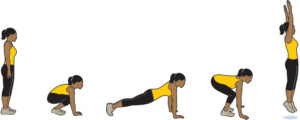
Burpee — 3×10
-
Jumping in place — 3×30 sec
-
High-knee running — 3×30 sec

Day 7 — rest
Cardio at home without equipment
Simple options:
-
jumping jacks;
-
jogging in place;
-
jump rope without a rope;
-
burpee.
Cardio helps burn calories, improve endurance, and lose weight.
Motivation for working out at home
-
Create a clear plan and put it somewhere visible.
-
Train at the same time every time.
-
Use music for energy.
-
Keep a workout diary.
-
Track your progress: “before/after” photos, measurements, and how you feel.
Common mistakes beginners make
-
Training is too infrequent.
-
Too much is done on the first day.
-
Skipping the warm-up.
-
Incorrect technique.
-
Quick results are expected without discipline.
Nutrition and recovery
-
Proteins — the building blocks of muscles.
-
Vegetables and fruit — vitamins and fiber.
-
Water — at least 1,5–2 l per day.
-
Sleep — 7–8 hours to recover.
Summary
Home workout without equipment is an easy, convenient, and effective way to stay fit. Consistency, proper technique, and gradual progress are important. In just a few weeks, you'll notice more energy, better posture, and a stronger body.
Remember: your body is the best training tool!