
← BACK
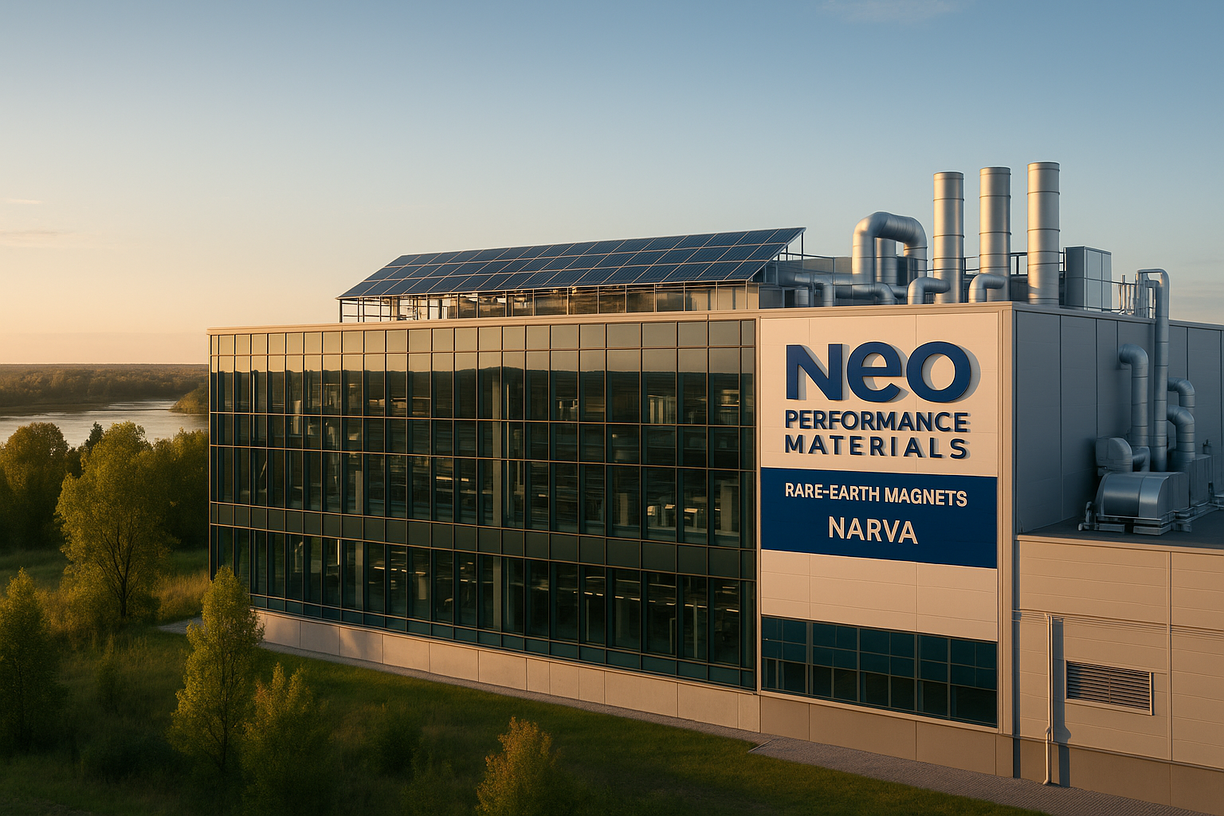
Narva rare-earth magnet factory: A new core of Europe's green transition
16.09.2025
Introduction
1.In September 2025, a production facility of historic significance was opened in Narva—Europe's first rare-earth magnet plant. This €75 million investment by the Canadian company Neo Performance Materials marks an important milestone in the European Union's efforts to reduce its dependence on China in the field of critical technologies. Narva rare-earth magnet plant is not merely a production facility—it is a symbol of Estonia's capacity for innovation and strategic importance in Europe's green transition.
Narva rare-earth magnet plant: a technological breakthrough
Narva rare-earth magnet plant is located on the Estonia–Russia border, in a region that has long faced economic challenges. The new production facility will bring revolutionary change to both the local economy and European energy security. The factory will be capable of producing 2000 tonnes of magnet blocks per year, enough to equip more than a million electric cars or a thousand offshore wind turbines.
Technological innovation and the production process
Narva rare-earth magnet plant uses state-of-the-art technologies to process rare earth elements. The production process begins with rare earth powders imported from Australia, which are combined with other metals using complex physical processes. The result is permanent magnets that are essential for modern green technologies.
The plant uses innovative solutions that ensure both environmental sustainability and production efficiency. Narva rare-earth magnet plant is designed to meet Europe's highest environmental requirements and quality standards.
Economic impact and employment
Narva rare-earth magnet plant brings significant economic benefits to the entire region. The plant currently employs about 80 people, but forecasts indicate that the number of employees could grow to as many as 1000 in the coming years. This means significant employment growth in a region that has long struggled with economic difficulties.
Investments and financing
The total cost of the project is 75 million euros, of which 14 million euros comes from the European Union's Just Transition Fund. The remainder consists of private investment, demonstrating the private sector's confidence in the project. Narva rare-earth magnet plant has also received support from the Estonian government, which sees the project as strategically important for the country's economic development.
European energy independence
One of the main objectives that Narva rare-earth magnet plant helps to achieve is increasing Europe's energy independence. Currently, the European Union imports 90% of its permanent magnet needs from China, which poses a significant geopolitical risk.
Strategic importance in the green transition
Narva rare-earth magnet plant plays a key role in Europe's green transition. Rare-earth permanent magnets are essential:
•For electric vehicle motors
•For wind turbine systems
•For renewable energy technologies
•For energy-efficient equipment
Without these magnets, Europe's green transition would be significantly slower and more expensive.
Local impact and community development
Narva rare-earth magnet plant will bring positive changes to the entire Ida-Virumaa region. The city of Narva, which has long depended on the oil shale industry, will now gain a new economic sector aligned with European environmental policy.
Education and skills development
The construction of the factory also requires training and skills development for the local workforce. Narva rare-earth magnet plant cooperates with local educational institutions to ensure the availability of skilled labour. This investment in human capital is just as important as physical infrastructure.
Environmental impact and sustainability
Narva rare-earth magnet plant is designed with sustainability principles in mind. The production process has been optimized to minimize environmental impact, using the most advanced purification and recycling technologies.
Circular economy principles
The plant follows the principles of the circular economy, recycling as many materials as possible and minimizing waste generation. Narva rare-earth magnet plant demonstrates how modern industry can be both economically viable and environmentally friendly.
The future and prospects for development
Narva rare-earth magnet plant is only the beginning of the development of Estonia's green technology sector. The project's success could lead to additional investments and similar projects in other regions of Estonia.
International cooperation
The plant strengthens Estonia's position in international technological cooperation. Narva rare-earth magnet plant is an example of how a small country can play an important role in global technology supply chains.
Challenges and opportunities
Although Narva rare-earth magnet plant brings many positive changes, the project also faces challenges. The geopolitical situation in the region, the shortage of skilled labour, and growing international competition are all factors that must be taken into account.
Competitive advantage
At the same time, it provides Narva rare-earth magnet plant a significant competitive advantage for Estonia in the European market. Proximity to key consumer markets, high-quality infrastructure, and a stable political environment make Estonia an attractive location for technology companies.
Summary
Narva rare-earth magnet plant is a remarkable achievement for both Estonia and Europe. This investment of 75 million euros will create up to 1000 jobs, reduce Europe's dependence on China and strengthen Estonia's position in green technology. The factory demonstrates that Estonia can be at the forefront of innovation and play an important role in shaping Europe's future. Narva rare-earth magnet plant is not just a production facility – it is an investment in the sustainable future of Estonia and Europe.