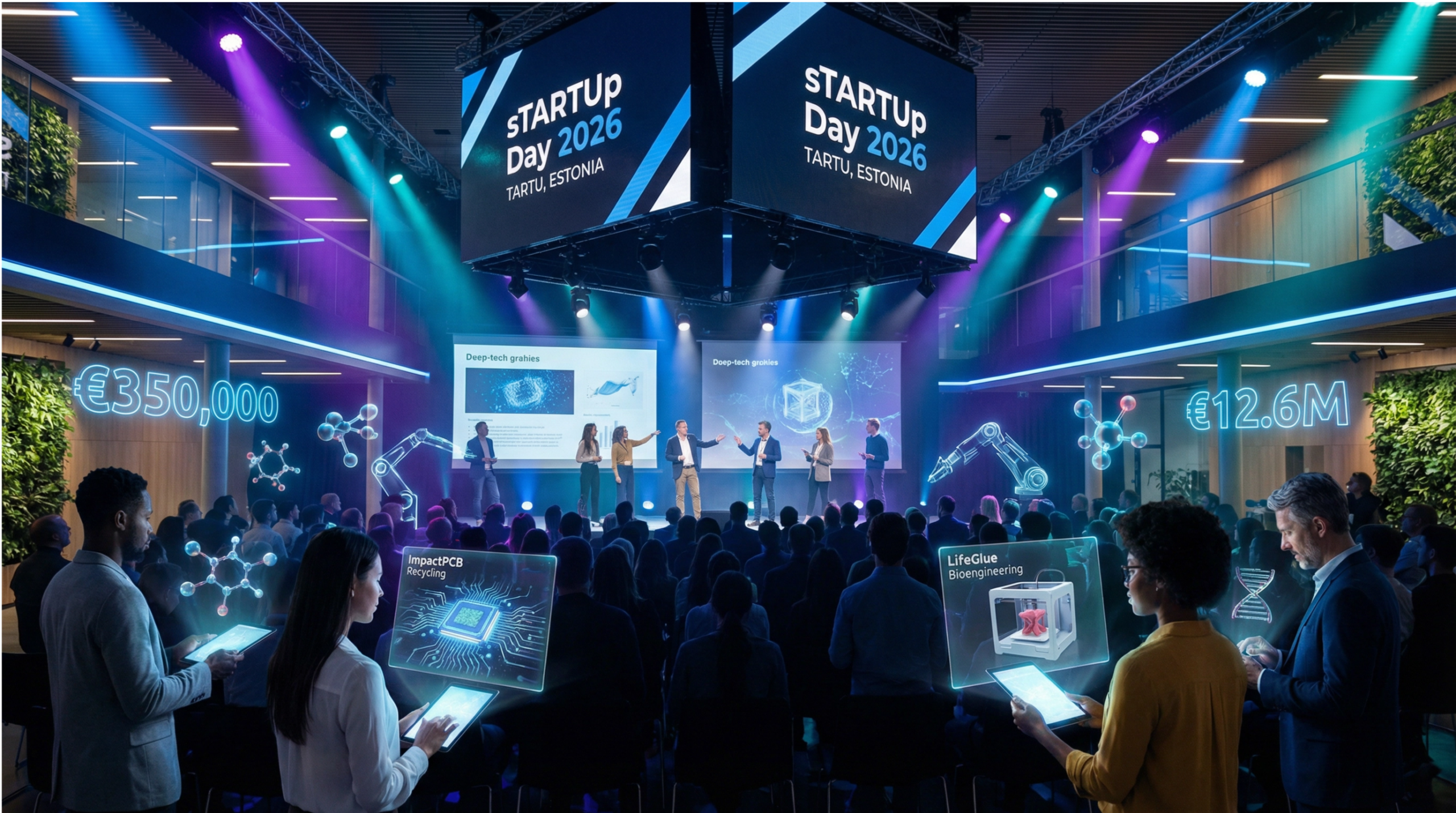
sTARTUp Day 2026: A growth engine worth 350 000 eurot ja riiklik 12,6 million euros is flowing into the Estonian DeepTech sector
Estonia’s largest business festival, sTARTUp Day 2026, which took place in Tartu, culminated in a number of significant announcements that reaffirm Estonia’s position as a hub for DeepTech innovation. Two promising start-ups, ImpactPCB and LifeGlue, secured a total of 350 000 euros in investment, whilst kui Eesti valitsus käivitas uue 12,6 million euros were allocated to an economic growth support programme to accelerate the development of research-intensive companies. These developments reflect a broader strategic shift that places research-based entrepreneurship at the heart of Estonia’s economic future.
Every winter, Estonian and international technology enthusiasts, investors, and entrepreneurs gather in Tartu to attend the sTARTUp Day festival, which has become the region's most important indicator of innovation trends. It is an event where bold ideas and smart money meet, creating the synergy essential for the emergence and growth of new technologies. The 2026 festival was no exception. The event's pitching competition, which is always the best barometer of investor confidence and enthusiasm, clearly belonged to deep technology, demonstrating investors' growing interest in complex, research-based solutions that address global challenges. This focus aligns with the global trend of viewing deep technology as having the potential to solve humanity's most pressing problems, from climate change to healthcare crises.
Two DeepTech startups receive an investment of 350 000 euros
The highlight of the sTARTUp Day 2026 pitching competition was the announcement of investment in two outstanding start-ups – ImpactPCB and LifeGlue. These companies are tackling critical challenges in the fields of sustainability and healthcare. A syndicate of angel investors led by EstBAN decided to invest up to 150 000 euros, to be shared between the two companies, whilst the venture capital fund BSV (Baltic Sandbox Ventures) contributed a further 200 000 euros specifically to LifeGlue. This brought the total investment amount to 350 000 euros. This is a significant sum for early-stage start-ups and clearly demonstrates that investors are prepared to invest in research-intensive projects with long-term potential, even if they involve a higher level of risk.
ImpactPCB: A revolution in the recycling of electronic waste
An Estonian start-up ImpactPCB has developed an innovative, chemical-free approach to recovering valuable metals from electronic waste. Traditional e-waste recycling relies heavily on harsh chemicals to extract precious metals such as gold, silver and rare earth elements from printed circuit boards. This process is not only harmful to the environment but also inefficient, leaving some valuable materials unrecycled. ImpactPCB’s dry mechanical processing offers a cleaner alternative, whilst enabling the recovery of both precious metals and critical metals – materials that are increasingly important for Europe’s manufacturing independence. Dependence on imported raw materials is a strategic concern for the European Union, and ImpactPCB technology offers a practical solution for promoting the circular economy and enhancing strategic autonomy.
The company has already generated revenue and has its first clients, tackling a problem that a representative of EstBAN Martin Goroško called it a “critical EU resource problem”. The technology's modular design allows it to be scaled as demand grows, offering a flexible and efficient solution to the growing e-waste problem. This means that the technology can be implemented in both small and large factories, adapting to different market conditions.
LifeGlue: the future of 3D bioprinting
The Finnish startup LifeGlue has developed a hyaluronic acid-based hydrogel platform specifically designed for the 3D-bioprinting of human tissues. Their patented bio-ink, called Glue4Life, acts as a printable matrix that supports living cells during the printing process and maintains cell viability as the tissues develop. This technology opens up new possibilities in regenerative medicine, drug testing and personalised medicine. For example, it makes it possible to print new tissues and organs from the patient’s own cells, thereby avoiding the risk of a rejection reaction. It can also be used to test new medicines in laboratory conditions, reducing the need for animal testing and speeding up drug development.
BSV general partner Sandra Golbreichi said that the investment reflects both the strength of the science underpinning LifeGlue and its broad application potential across the life sciences sector. Also noteworthy is the fact that this is a women-led company, co-founded by Finnish scientists turned entrepreneurs Paula Puistola, Laura Kuittinen and Anni Mörö. This is an important sign of progress toward gender equality in the technology sector, which has traditionally been a male-dominated field.
In addition to the main winners, other startups were also recognized. Swedbank awarded a prize of 10 000 euros to BabAI Orbital artificial intelligence designed to prevent collisions between these satellites. This is a topical issue, given the rapid growth in the number of satellites orbiting the Earth and the problem of space debris. Several start-ups also received legal support packages from the law firms Sorainen and TRINITI, whilst Values360Ventures offered an integrated STEM education platform Practical an annual mentoring package worth 120 000 euros. This shows that the sTARTUp Day ecosystem offers not only financial support, but also essential mentoring and legal advice, which are critically important for early-stage startups.
Winner
Field
Award/Investment
ImpactPCB
Electronic waste recycling
Share 150 000 € of the EstBAN syndicate
LifeGlue
3D-bioprinting
A portion of 150 000 € from the EstBAN syndicate + 200 000 € from BSV
BabAI Orbital
Space technology (AI)
10 000 € from Swedbank
Practical
Educational Technology (STEM)
Mentorship worth 120 000 €
Valitsus käivitab 12,6 million euros for the DeepTech growth engine
In addition to private-sector investments, the Estonian government announced a new strategic initiative at the “Thinking in Billions” side event held as part of sTARTUp Day. Minister of Economic Affairs and Industry Erkki Keldo kuulutas välja 12,6 million euro programme aimed at accelerating the development of deep-tech companies. Over the next four years, the aim is to create 37 internationally competitive and research-intensive companies. This is a clear sign that the state considers deep tech a strategic priority and is prepared to invest in its long-term development.
Minister Keldo emphasized that this investment will help new research-based companies overcome early growth challenges, the so-called “valley of death,” enabling them to bring innovative ideas to market, following success stories such as Starship with its parcel delivery robots, Skeleton Technologies with its energy storage devices, and Milrem Robotics with its unmanned vehicles. These companies are excellent examples of how research-intensive ideas can grow into globally successful companies, creating high-value-added jobs and strengthening the Estonian economy.
“While technological development enabled the startup boom, the next wave of innovation that will positively redefine the economy is deep technology. If we want to lead this wave, we must support the bridge between ideas born in laboratories and everyday life—which is precisely what the DeepTech startup network does,” Keldo said.
The investment will be used to create the DeepTech startup network, bringing together the expertise of Sparkup Tartu Teaduspark, Tehnopol, Tartu Ülikool, TalTech, and Eesti Maaülikool. It is a unique public-private partnership that combines the cutting-edge knowledge of research institutions with the practical experience of science parks in developing companies. The network's four-year action plan is ambitious:
•Map 350 potential deep-tech ideas.
•Organise pre-incubation for 200 teams, 57 of which will continue in the accelerator.
•Provide startups with over 10 000 hours of mentoring support.
•Launch 37 new operational deep-tech companies.
The state is supporting the programme with 12,6 million euros, and the network will also help companies raise approximately 38 million euros in capital, of which 29 million euros is expected to come from private investments. This means that the state investment acts as a catalyst, attracting a significantly larger amount of private capital, which is essential for the growth of startups.
The bigger picture: the future of Estonia's research-based economy
Both the contribution of private investors and the government's new support programme reflect a broader consensus: Estonia's future economic growth lies in research-intensive entrepreneurship. This is a strategic choice that requires a long-term vision and consistent investment. Member of the Management Board of Tehnopol Agnes Roos noted that although high-level research is conducted at Estonian universities and research institutions, its value too often fails to reach everyday life. A member of the management board of Sparkup Tartu Teaduspark That's fine added that many good ideas stall at an early stage precisely because of their complexity and high risk. The purpose of the network is to share these risks with entrepreneurs and researchers. This is an important step toward bridging the gap between academia and the business world and promoting the commercialisation of research results.
According to Startup Estonia, 1620 startups operated in Estonia in 2025, including 216 deep-tech companies. Deep-tech startups paid 68 million euros in labour taxes to the state, which is 27% more than in the previous year, and attracted nearly 161 million euros in investments, accounting for more than half of the total investment volume in the startup sector. This clearly demonstrates the sector's steady growth and increasing importance in the Estonian economy. These numbers speak for themselves: deep technology is no longer a niche field but an important industry that creates jobs and generates revenue for the country.
All in all, sTARTUp Day 2026 was more than just a festival – it was a demonstration of Estonia’s commitment to being at the forefront of the DeepTech revolution. Strategic investments from both the private sector and the state are creating fertile ground for the emergence of the next generation of global technology leaders right here in Estonia. This is a bold step towards the future, underpinned by knowledge, innovation and collaboration. All that remains is to wait and see what new success stories sTARTUp Day 2027 will bring and how they will shape the future of Estonia and the world as a whole.
Is your interior outdated? We’ll give it a new lease of life!
18.00€
Tallinn, Eesti
Reset password
Manage Consent
To provide the best experiences, we use technologies like cookies to store and/or access device information. Consenting to these technologies will allow us to process data such as browsing behavior or unique IDs on this site. Not consenting or withdrawing consent, may adversely affect certain features and functions.
Functional
Always active
The technical storage or access is strictly necessary for the legitimate purpose of enabling the use of a specific service explicitly requested by the subscriber or user, or for the sole purpose of carrying out the transmission of a communication over an electronic communications network.
Preferences
The technical storage or access is necessary for the legitimate purpose of storing preferences that are not requested by the subscriber or user.
Statistics
The technical storage or access that is used exclusively for statistical purposes.The technical storage or access that is used exclusively for anonymous statistical purposes. Without a subpoena, voluntary compliance on the part of your Internet Service Provider, or additional records from a third party, information stored or retrieved for this purpose alone cannot usually be used to identify you.
Marketing
The technical storage or access is required to create user profiles to send advertising, or to track the user on a website or across several websites for similar marketing purposes.