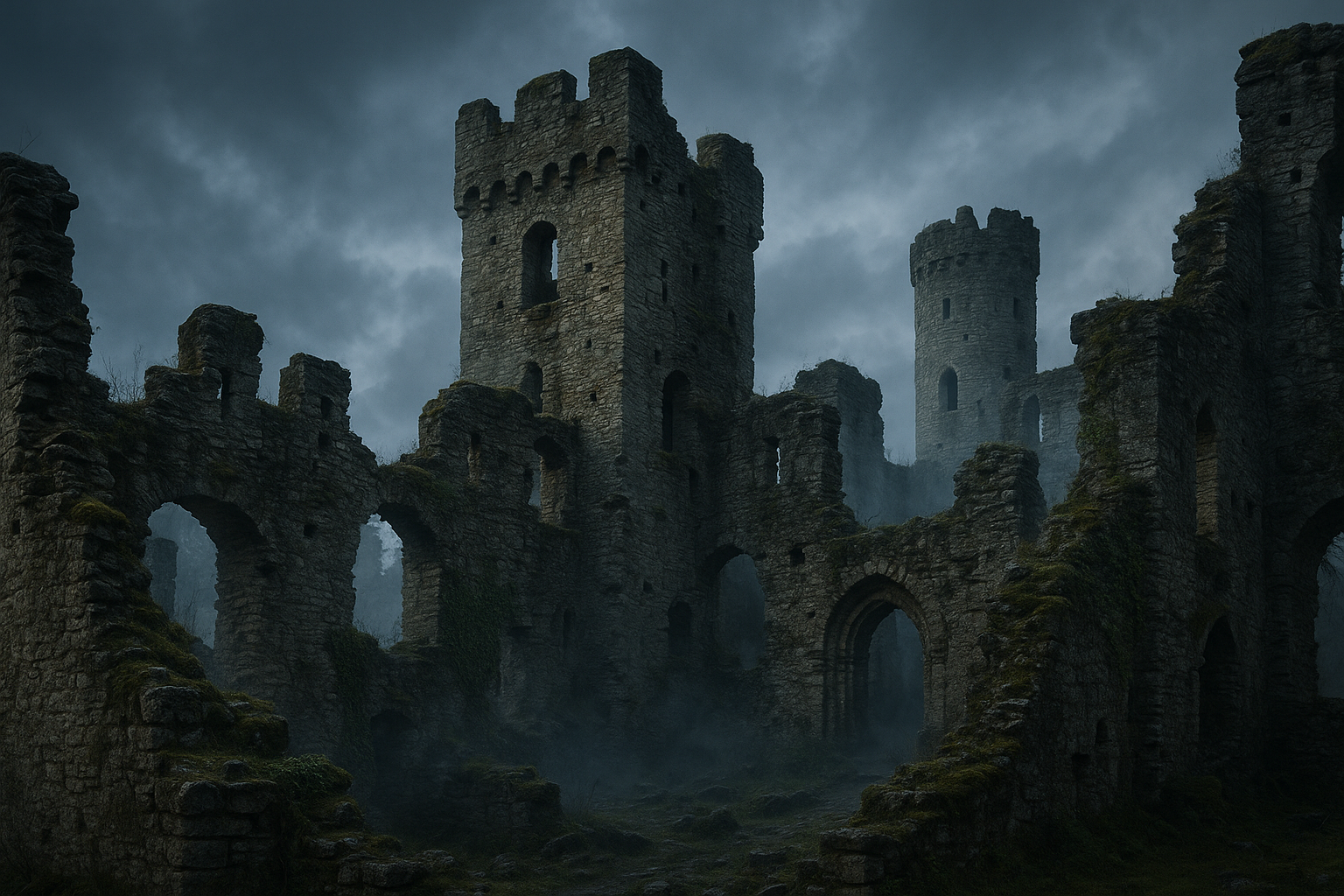
5 abandoned castles in Estonia that tourists do not know about
Estonia, a country with a rich history spanning centuries, harbors many secrets and mysteries. Its medieval castles, scattered across picturesque corners of the country, are not merely ruins, but silent witnesses to bygone eras, filled with legends, ghosts, and hidden stories. In this article, we embark on a journey to five abandoned Estonian castles that rarely appear in tourist guides but conceal far more than meets the eye.
1. Maasilinna loss (Soneburg): The Castle of Punishment on Muhu Island
On the northern coast of Muhu Island, hidden away from the bustling tourist trails, lie the ruins of Maasilinna Castle, also known by its harsh German name – Soneburg, meaning “castle of punishment” or “castle of redemption”. The name itself hints at its dramatic origins.
Legend of the penalty: The history of the castle began in 1345, immediately after the brutal suppression of the St. George's Night Uprising, when local Estonians dared to challenge the rule of the German crusaders. After the uprising had been drowned in blood, Burchard von Dreileben, Master of the Livonian Order, ordered the local people, as punishment and as an eternal reminder of their submission, to build a new stone castle on the site of the destroyed Estonian stronghold. Thus, the defeated built the symbol of their own defeat. Every stone in the walls of Maasilinn still seems to preserve the memory of hard labour and humiliation.
Hidden history: Located in a strategically important harbour, the castle served not only to intimidate but was also an important administrative and military centre that controlled eastern Saaremaa and the island of Muhu. Its walls saw Swedish flags when the castle was captured twice in the XVI century, as well as destruction and periods of neglect. Today, walking among its ruins, it is easy to imagine the Order's ships entering the harbour and guards keeping watch on the walls, gazing out to sea. It is said that on quiet moonlit nights, moans and whispers in ancient Estonian can be heard here—perhaps the voices of the builders who were forced to build their own prison, or the spirits of warriors who fell in an unequal struggle.
2. Vastseliina lossi varemed (Neuhausen): The Holy Miracle and the Curse of the Great Northern War
In southeastern Estonia, the proud ruins of Vastseliina piiskopilossi, also known as Neuhausen, rise on the picturesque bank of the Piusa River. This place is shrouded not only in military history but also in a profound religious mystery that attracted pilgrims from all over Europe.
Legend of the White Cross: The castle's most famous legend says that in 1353, a miracle occurred in the castle chapel. During a service, several people saw a shining white cross on the wall above the empty altar. This sign was interpreted as a divine blessing, and word of it quickly spread throughout Livonia and beyond its borders. Pope Innocent VI officially recognised the miracle and granted a 40-day indulgence to all who made a pilgrimage to Vastseliina. The castle became one of the most famous pilgrimage centres in Northern Europe. It is said that even today, a special aura can be felt among the chapel ruins, and some pilgrims claim to have seen a mysterious glow on the old walls.
Hidden history: In addition to its spiritual significance, Vastseliina was one of the most powerful and impregnable fortresses on the eastern border of Livonia. Its mighty walls and towers provided reliable protection against Russian forces. However, its glorious history was cut short during the Great Northern War. In 1702, after a fierce assault, the troops of Peter I captured and destroyed the castle. It has not been restored since. Today, the castle ruins are not only a tourist attraction, but also a place reportedly inhabited by ghosts. Local residents speak of a monk who wanders among the ruins and of the sounds of church singing coming from the ruined chapel. Perhaps these are the souls of those who died here during the war, or eternal pilgrims still searching for their miracle.
3. Keila-Joa loss (Fall): Romanticism, Intrigue and the Shadow of the Chief of Gendarmes
Unlike austere medieval fortresses, Keila-Joa loss ehk Fall is an example of XIX-century Gothic Revival romanticism. Located by the picturesque waterfall of the Keila river, it was not a military citadel, but a luxurious manor, a center of social life, and a place that concealed the secrets of the Russian aristocracy.
Legend of Unrequited Love: Although the castle is relatively young, its surroundings are shrouded in older legends. One tells of a miller's daughter who fell in love with a knight from a fortress that once stood here. Their love was doomed because of differences in social status. Unable to bear their separation, the girl threw herself into the raging waters of the waterfall. It is said that her spirit still appears by the water on moonlit nights, and her sorrowful song can be heard blending with the roar of the falling water.
Hidden history: The castle was built in 1833 for one of the most influential and feared figures of the era of Nicholas I – Count Aleksandr Hristofoorovitš Benckendorff, head of the Third Section of His Imperial Majesty’s Own Chancellery, in other words, Russia’s chief of the gendarmes. In an irony of fate, the man who kept an entire empire in fear created an idyllic nest for himself and his family in the style of European Romanticism. The architect was the famous Andrei Stackenschneider. The “Fall” manor (“waterfall” in German) became a centre of attraction for Saint Petersburg high society. Emperors, poets and composers visited it. But behind the glittering façade lurked political intrigues and secret denunciations. One can only guess what state secrets were discussed in the castle’s luxurious salons and what fates were decided to the roar of the waterfall. Some researchers claim that the castle had secret passages and eavesdropping rooms, which would have been entirely in keeping with its owner’s character.
4. Otepää Castle ruins (Odenpäh): The bear’s head and the first brick fortress
Today, Otepää is known as Estonia's winter capital, but high on the Linnamägi hill overlooking the town lie ruins that preserve the memory of the times when great history was made here. These are the remains of Odenpähi Castle, or “Karupea,” as it was called in Russian chronicles.
Legend Karupeаst: The name “Odenpäh” comes from the Estonian words “ott” (bear) and “pää” (head). Legend links this name to an ancient bear cult, in which the bear was sacred to the local tribes. It is said that in pre-Christian times there was a sanctuary on this hill where the leaders of the Ugandi tribe performed rituals, asking the spirit of the bear for strength and protection. When the crusaders came to these lands, they built their castle on the site of the pagan sanctuary, attempting to eradicate the old faith. But the spirit of the place proved stronger. At night, when mist surrounds the hill, some people see the outline of a gigantic bear’s head among the ruins, and a deep roar can be heard from beneath the ground – it is the spirit of the ancient master, unable to find peace.
Hidden history: Otepää Castle is of immense historical importance. It was here that, in 1224, Tartu Bishop Hermann I built the first fully brick-built stone fortress in Estonia, an innovation at the time. The castle became the crusaders' most important stronghold in Estonian lands. But its time was short. In 1396, during a power struggle in Livonia, the castle was destroyed by the forces of the Teutonic Order and was never rebuilt. Today, looking at the modest ruins, it is difficult to imagine that one of the most modern fortresses of its time once stood here. Archaeological excavations have uncovered only a small part of the secrets of “Karupea,” and who knows what other secrets the ancient Linnamägi still conceals.
5. Kuressaare Castle: The Secrets of the Walled-In Knight and the Lion Pits
Kuressaare Castle in Saaremaa is one of the best-preserved medieval castles in the Baltic states. Most tourists visit its ceremonial halls and imposing fortifications, but the most terrifying and fascinating stories are connected with its lesser-known, hidden parts.
The legend of the walled-in knight: Kuressaare’s most famous and darkest legend is the story of the walled-up knight. In 1785, while renovating the castle, workers discovered a sealed wall in one of the cellars. Behind it, they found a small room where a human skeleton in medieval knight’s armor sat at a table. In front of it stood a pewter jug and lay a decayed book. Several versions of this story exist. According to one, he was an inquisitor sent to the island in the XVI century to fight the spread of Protestantism. He fell in love with a local girl, breaking his vow of celibacy, and for this his brothers walled him up alive. According to another version, he was a Swedish nobleman who rebelled against the bishop’s authority. Whoever this unfortunate man was, his spirit reportedly still wanders through the castle cellars, and sometimes at night the clanking of armor and quiet moaning can be heard.
Hidden history: In addition to the cellar with the knight, the castle has other secret places. One of them is the so-called “Lion’s Pit”. It is a deep well in the courtyard where, according to legend, convicts were thrown as food for wild animals (although historians doubt that lions were actually kept there; they were probably wolves or bears). The castle also has an intricate system of underground passages, part of which remains unexplored. It is said that one of these passages leads far beyond the castle grounds, to the seashore. These secret passages were used not only to escape during sieges, but also for clandestine meetings and conspiracies. Exploring the lesser-known corners of Kuressaare Castle offers a glimpse of its dark side, hidden behind the façade of a proud and inaccessible fortress.
These five castles are only a small part of Estonia's historical heritage. Each one conceals its own unique stories and legends, awaiting someone to explore them. When visiting these places, you will not only see ancient ruins but may also hear the voices of the past whispering their secrets to those who are ready to listen.
To provide the best experiences, we use technologies like cookies to store and/or access device information. Consenting to these technologies will allow us to process data such as browsing behavior or unique IDs on this site. Not consenting or withdrawing consent, may adversely affect certain features and functions.
Functional
Always active
The technical storage or access is strictly necessary for the legitimate purpose of enabling the use of a specific service explicitly requested by the subscriber or user, or for the sole purpose of carrying out the transmission of a communication over an electronic communications network.
Preferences
The technical storage or access is necessary for the legitimate purpose of storing preferences that are not requested by the subscriber or user.
Statistics
The technical storage or access that is used exclusively for statistical purposes.The technical storage or access that is used exclusively for anonymous statistical purposes. Without a subpoena, voluntary compliance on the part of your Internet Service Provider, or additional records from a third party, information stored or retrieved for this purpose alone cannot usually be used to identify you.
Marketing
The technical storage or access is required to create user profiles to send advertising, or to track the user on a website or across several websites for similar marketing purposes.