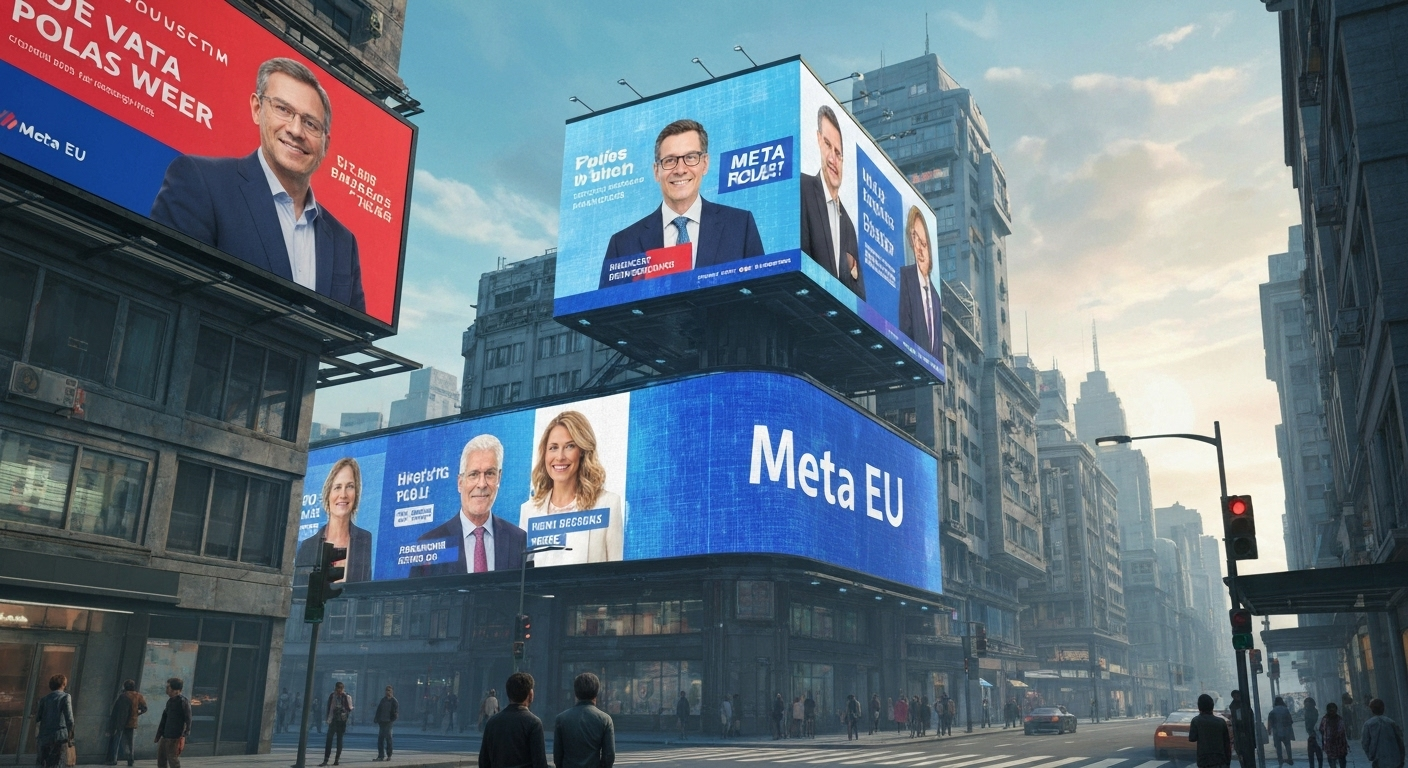
Meta to end political and social advertising in the European Union
26.08.2025
Brief summary
Meta Platforms Inc., which owns the social networks Facebook and Instagram and the messaging app WhatsApp, announced that it will discontinue political, electoral, and social issue advertising in European Union countries starting in October 2025. The decision was made in connection with the entry into force of the EU's new Regulation on the Transparency and Targeting of Political Advertising (TTPA), which the company considers “unworkable” due to excessive restrictions and legal uncertainty.
Details of Meta's decision
Meta Platforms Inc. issued a statement on July 25, 2025, announcing its decision to stop publishing political, electoral, and social issue advertising on its platforms in European Union countries starting in October 2025 [1]. The company explained that its decision was prompted by the EU's new Regulation on the Transparency and Targeting of Political Advertising (TTPA), which creates an “unacceptable level of complexity and legal uncertainty” for advertisers and platforms operating in the EU.
“Unfortunately, the TTPA imposes significant additional obligations on our processes and systems, creating an unacceptable level of complexity and legal uncertainty for advertisers and platforms operating in the EU,” the company said in a statement [1].
Meta is particularly concerned about the restrictions that the TTPA places on ad targeting and delivery:
“For example, the TTPA imposes extensive restrictions on ad targeting and delivery, which would limit the ability of political and social issue advertisers to reach their audiences and result in people seeing less relevant advertising on our platforms,” the company noted [2].
Meta's decision affects all its platforms in the EU, including Facebook, Instagram, and WhatsApp. However, the company emphasized that its decision applies only to the European Union and that it will continue to offer its political advertising tools in other regions of the world.
The TTPA Regulation and its requirements
The EU Regulation on the Transparency and Targeting of Political Advertising (TTPA) will enter into force on 10 October 2025 [2]. Its main objective is to combat information manipulation and foreign interference in elections and to regulate the processing of personal data for political advertising.
The main TTPA requirements include:
1.Labelling of political advertising — all political advertisements must be clearly labelled and include information about who paid for them.
2.Information about the connection to elections — the advertisement must include information about which election or political process it is associated with.
3.Disclosure of targeting methods — it must be disclosed whether targeting or ad delivery methods were used to reach the user.
4.Restrictions on the use of personal data — targeting or serving advertisements is permitted only if users give explicit and separate consent to the use of their data for political advertising.
5.Prohibition on the use of sensitive data — special categories of personal data, such as race, ethnic origin and political views, may not be used for profiling.
6.Protection of minors — minors' personal data must not be used, and the use of data belonging to a user who is at least one year younger than the national voting age is also prohibited.
7.Ban on foreign interference — the TTPA also imposes a ban on political advertising from sponsors originating outside the EU during the three months preceding an election or referendum [2].
Meta's existing transparency tools
Meta, like other social platforms, already has certain tools in place to ensure transparency in political advertising. The company noted that since 2018, advertisers publishing political ads have been required to provide detailed information to verify their identity and place of residence. Such ads also include the disclaimer “paid for by [sponsor name]” [2].
However, Meta believes that the TTPA imposes “significant additional obligations” that the company considers excessive. Meta argues that the regulation represents “yet another threat to the principles of personalized advertising” and that changing these services will render them ineffective.
“Once again, we see regulatory obligations effectively removing popular products and services from the market, reducing choice and competition,” Meta stated [2].
A decision similar to Google’s
Meta is not the only technology company to have made such a decision. At the end of 2024, Google also announced that it would stop publishing political ads in the EU starting in October 2025 due to similar issues with the TTPA [1].
Google stated that the TTPA “will introduce significant new operational challenges and legal uncertainties for political advertisers and platforms” [1]. The company is particularly concerned about the regulation's broad definition of political advertising:
“For example, the TTPA defines political advertising so broadly that it could encompass ads related to an extremely wide range of issues that are difficult to reliably identify at scale,” Google noted in its statement [1].
Google also cited the lack of reliable local election data that would make it possible to consistently and accurately identify all ads related to any local, regional, or national election in any of the 27 EU Member States.
Meta's history of conflicts with EU regulators
Meta's decision to end political advertising in the EU is part of broader tensions between the company and European regulators. Meta CEO Mark Zuckerberg has repeatedly expressed dissatisfaction with EU regulation, previously accusing the EU of “censorship” and equating fines with tariffs [3].
Meta currently faces a fine of 200 million euros (235 million dollars) for violating personal data processing rules on Facebook and Instagram, with the possibility of additional daily fines if changes are not made [3].
Earlier this year, the EU launched an investigation into TikTok following the tumultuous presidential election in Romania, which resulted in a victory for the far-right, pro-Russian candidate Călin Georgescu. Part of the investigation concerns the platform’s policy on political advertising and paid political content, which the social network says it prohibits [2].
Consequences for political communication in the EU
Meta and Google's decision to stop publishing political advertising in the EU could significantly affect political communication in the region. These platforms are important channels for political parties and candidates, particularly for reaching young voters.
Without the ability to publish political advertising on the largest social platforms, political actors may be forced to seek alternative communication channels or rely more heavily on organic reach, which may be less effective in reaching a broad audience.
Meta emphasized that its decision will not prevent people in the EU from continuing to discuss politics on its platforms or politicians, candidates, and political officials from creating and sharing political content organically. “They just won't be able to amplify it through paid advertising,” the company noted [1].
European Commission's response
There has not yet been an official response from the European Commission to Meta's decision. However, the European Commission, which drafted the TTPA regulation, has previously stated that the legislation is intended to give EU citizens greater insight into political messaging and protect democratic processes [3].
The European Commission has repeatedly criticized Meta for using personal data for advertising. In the context of this long-running confrontation, Meta's decision can be viewed as yet another episode in the ongoing conflict between technology giants and European regulators.
Conclusions
Meta's decision to stop publishing political, electoral, and social issue advertising in the EU reflects growing tensions between technology companies and European regulators. The company believes that the new rules create excessive complexity and legal uncertainty, making it impossible to provide political advertising services effectively.
This decision could significantly affect political communication in the EU, especially ahead of elections. Political parties and candidates will have to adapt their digital marketing strategies and seek alternative channels to reach voters.
At the same time, this decision highlights the broader trend toward stricter regulation of technology platforms in the EU and the growing focus on transparency, data protection, and preventing foreign interference in democratic processes.
Discover the artist within you! Art courses in Tallinn.
19.00€
Endla tn 4-407, Tallinn, Eesti
Reset password
Manage Consent
To provide the best experiences, we use technologies like cookies to store and/or access device information. Consenting to these technologies will allow us to process data such as browsing behavior or unique IDs on this site. Not consenting or withdrawing consent, may adversely affect certain features and functions.
Functional
Always active
The technical storage or access is strictly necessary for the legitimate purpose of enabling the use of a specific service explicitly requested by the subscriber or user, or for the sole purpose of carrying out the transmission of a communication over an electronic communications network.
Preferences
The technical storage or access is necessary for the legitimate purpose of storing preferences that are not requested by the subscriber or user.
Statistics
The technical storage or access that is used exclusively for statistical purposes.The technical storage or access that is used exclusively for anonymous statistical purposes. Without a subpoena, voluntary compliance on the part of your Internet Service Provider, or additional records from a third party, information stored or retrieved for this purpose alone cannot usually be used to identify you.
Marketing
The technical storage or access is required to create user profiles to send advertising, or to track the user on a website or across several websites for similar marketing purposes.